


























Crash Barrier Design & Specifications in India: Height, Post Spacing & Thickness (IRC & MoRTH)






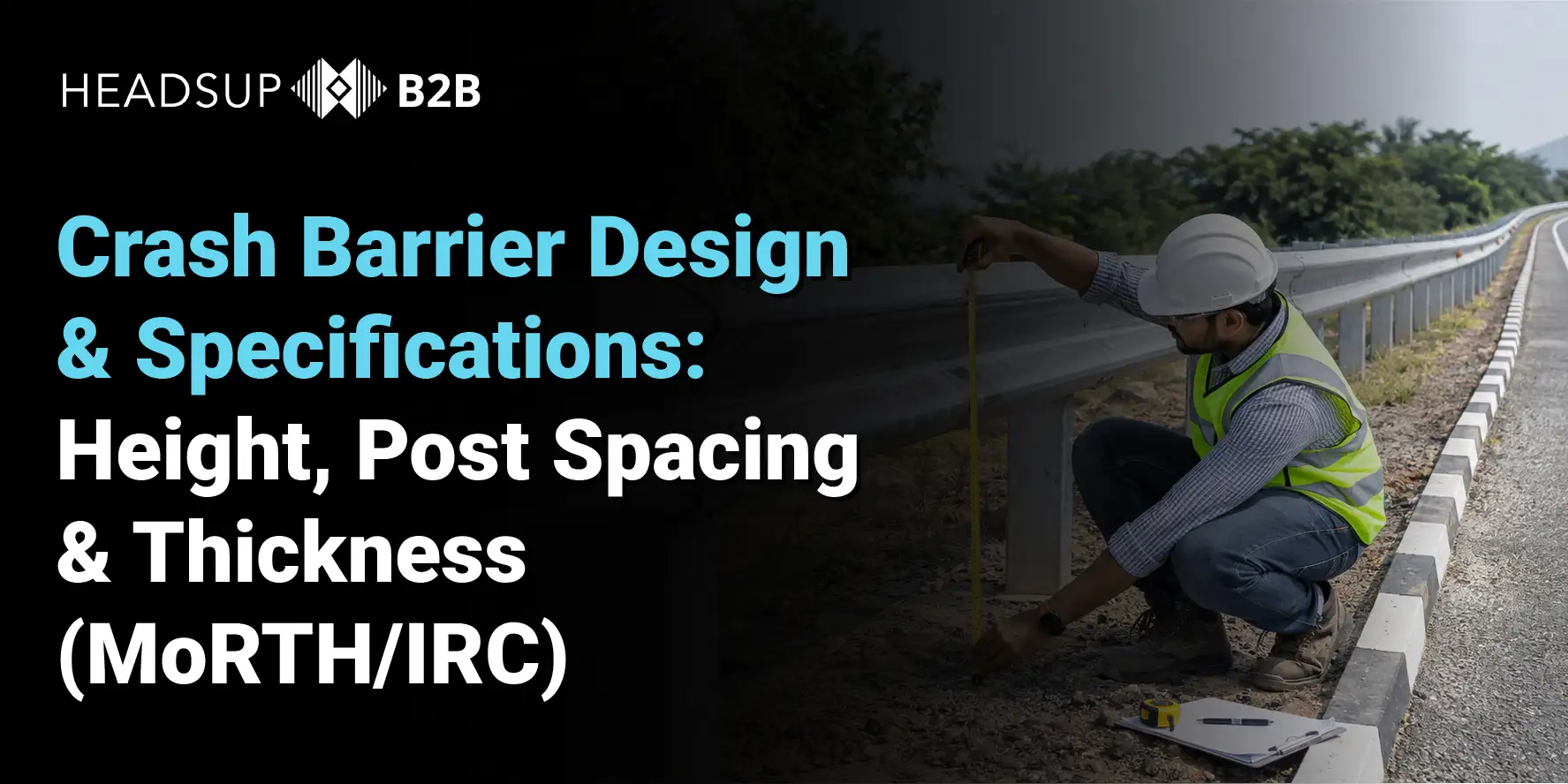
W-beam and thrie-beam design explained — the standards that apply, containment levels, working width, and the height, spacing and thickness values used in crash-tested systems.
Source: IRC:119-2015; IS 12699:1989 (via InfraLens); manufacturer test data, as of November 2026.
WHAT THIS GUIDE COVERS
- Standards that govern crash barrier design in India
- Containment levels and working width explained
- W-beam vs thrie-beam: design specifications
- Key design parameters and why they matter
- Where to use which barrier
- Design and procurement checklist
A crash barrier is only as safe as its design. The same W-beam profile can pass or fail a crash test depending on post spacing, height, steel thickness and how it is anchored. For highway contractors, getting the specification right is also what gets the barrier approved on NHAI and MoRTH projects.
1. Standards That Govern Crash Barrier Design in India
| STANDARD / GUIDELINE | WHAT IT COVERS |
|---|---|
| IRC:119-2015 | Guidelines for traffic safety barriers — warrants, selection, placement, containment levels |
| MoRTH Specifications for Road and Bridge Works | Material, galvanising, fabrication and installation requirements |
| IS 12699:1989 | W-beam metal crash barrier component specification (dimensions, material, coating) |
| EN 1317 (Parts 1 & 2) | European crash-test standard — containment level, working width, impact severity |
| MASH / AASHTO M180 | US crash-test protocol and guardrail component specification |
| IRC:SP:84, SP:87, SP:99 | Manuals for highway projects that reference safety barrier requirements |
Source: IRC, MoRTH and BIS publications; manufacturer compliance statements, as of November 2026. Always follow the project’s contract specification.
The key shift in recent years: Indian highway projects increasingly require barriers that have been crash-tested as a complete system, not just made to component dimensions. IS 12699 defines the beam; EN 1317 and MASH prove the system works.
2. Containment Levels and Working Width Explained
EN 1317 rates a barrier on three things: what size vehicle it can contain, how far it deflects, and how severe the impact is for occupants.
| TERM | MEANING | EXAMPLE |
|---|---|---|
| Containment level | Vehicle mass, speed and angle the barrier is tested to stop and redirect | N2 = cars at high speed; H1 = 10-tonne truck; H2 = 13-tonne bus |
| Working width (W1–W8) | Maximum lateral deflection of the barrier on impact | W4 ≤ 1.3 m; W5 ≤ 1.7 m |
| Impact severity (ASI A/B/C) | How hard the impact is on car occupants | Class A is the gentlest |
Source: EN 1317-2 classification framework; manufacturer test reports, as of November 2026.
Working width is a site question. If there is a pier, tree or drop within 1.3 m behind the barrier, a system with W5 deflection is not suitable there.
3. W-Beam vs Thrie-Beam: Design Specifications
| PARAMETER | W-BEAM | THRIE-BEAM |
|---|---|---|
| Profile | Two corrugations | Three corrugations |
| Beam width | 312 mm | About 505 mm |
| Beam thickness | 2.67–3.0 mm (3.0 mm min. under IS 12699) | About 3.0 mm |
| Beam length | 4,318 mm overall; ~3,810–4,000 mm effective | Similar standard lengths |
| Post section | Typically 150 × 75 mm C-post, 5 mm thick | Heavier posts as per tested system |
| Post spacing | Typically 2 m (some tested systems 4 m) | Typically 2 m |
| System height | About 740–750 mm (tested systems) | About 1,000–1,050 mm |
| Zinc coating | 550 g/m² minimum (IS 12699) | Often 610 g/m² specified |
| Typical containment | N2 to H1 | H1 to H2 |
Source: IS 12699:1989; EN 1317 test data published by Indian manufacturers (Utkarsh India, KP Green Engineering, Tata Nexarc), as of November 2026. Values vary by tested system — use the exact tested configuration.
For the full comparison, see W-beam vs thrie-beam crash barriers.
4. Key Design Parameters and Why They Matter
Height
Too low, and vehicles vault over; too high, and small cars slide under. Install at the exact height of the tested system and allow for future road overlays.
Post spacing
Closer spacing makes the barrier stiffer and reduces deflection. Changing spacing from the tested configuration changes its performance.
Steel thickness and grade
Thickness and yield strength decide how much energy the beam absorbs. Check mill certificates against the specification.
Galvanising
Hot-dip galvanising protects against corrosion for decades. Thin coatings fail early, especially near the coast.
Spacers (blockouts)
Spacers hold the beam away from the post so wheels do not snag on posts during impact.
End terminals
An untreated beam end can spear a vehicle. Use crash-tested terminals or flared and anchored ends as per IRC guidance.
Transitions
Where a W-beam meets a thrie-beam or concrete barrier, use a tested transition to avoid weak points.
5. Where to Use Which Barrier
| LOCATION | TYPICAL CHOICE | WHY |
|---|---|---|
| Highway shoulders and embankments | W-beam (N2/H1) | Contains cars and light vehicles at highway speeds |
| Medians on high-speed roads | W-beam or thrie-beam, double-sided | Prevents cross-median crashes |
| Bridges, flyovers, hill roads | Thrie-beam (H1/H2) | Higher containment where run-off is severe |
| Near hazards with little clearance | System with small working width | Limits deflection into the hazard |
| Very high-risk locations | Concrete barriers (H2/H3 and above) | Rigid, minimal deflection |
Source: Headsup B2B guidance based on IRC:119-2015 principles. Final selection must follow the project’s design and IRC warrants.
More on barrier types: types of crash barriers. Choosing a supplier: top metal beam crash barrier companies in India.
6. Design and Procurement Checklist
- Confirm the containment level and working width required by the project design.
- Ask for the EN 1317 or MASH crash test report — and check it matches the exact system being supplied (post spacing, height, beam thickness).
- Verify beam thickness, steel grade and zinc coating with mill and galvanising certificates.
- Check the supplier’s approval status for NHAI or state PWD projects where required. See the NHAI product approval process.
- Include end terminals, transitions and spacers in the BOQ — not just beams and posts.
- Plan installation by trained crews; incorrect post embedment can cancel out a good design.
⚠ COMMON MISTAKES
- Changing post spacing or height from the crash-tested configuration.
- Accepting a test report for a different system than the one supplied.
- Leaving untreated beam ends instead of tested terminals.
- Placing a barrier where the working width hits a hazard.
- Skipping galvanising certificates in coastal or high-humidity areas.
KEY TAKEAWAYS
- IRC:119-2015 is the primary Indian guideline for traffic safety barriers.
- System performance is proven by crash testing to EN 1317 or MASH.
- Standard W-beams are 312 mm wide, with 3 mm minimum thickness under IS 12699.
- Tested W-beam systems typically use 2 m post spacing and ~750 mm height.
- Choose containment level and working width from the site, not the catalogue.
- Include terminals, transitions and spacers in the BOQ.
Need Crash-Tested Barriers for Your Project?
✓ W-beam, thrie-beam & end terminals ✓ Verified suppliers ✓ Pan-India delivery
Explore crash barriers on Headsup B2B.
Disclaimer: Specifications are compiled from IRC, MoRTH and BIS publications and manufacturer test data, and are indicative as of November 2026. Design values vary by tested system. Always follow the project’s approved design, contract specifications and the latest IRC and MoRTH guidance.
Frequently Asked Questions
Share
