


























W-Beam Crash Barrier Price Per Meter 2026






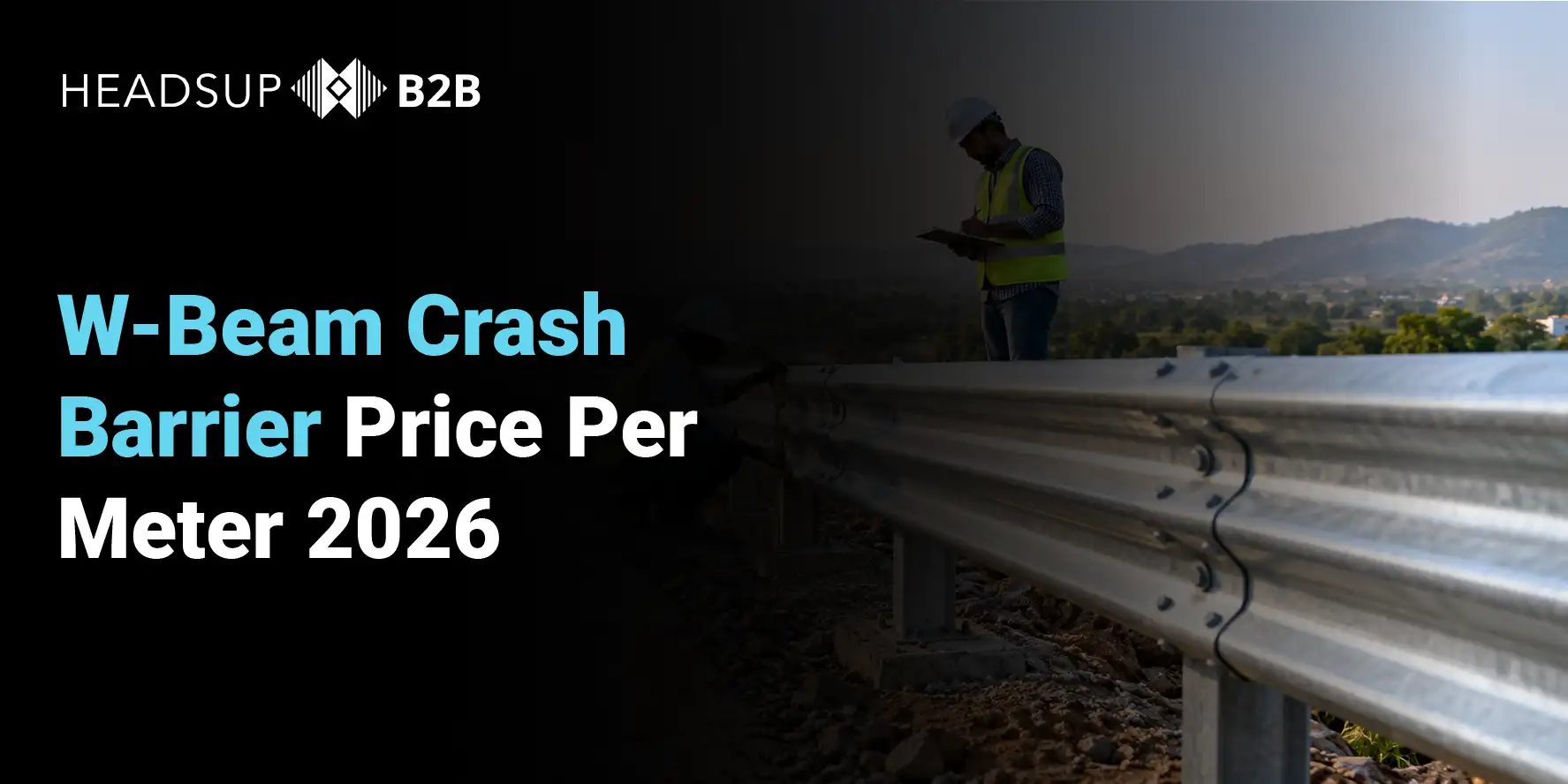
W-beam crash barrier quotes come per metre, per kilogram, supply-only or installed, with or without posts and end terminals. This guide gives you estimated 2026 price ranges, explains what a “per metre” rate should include, and shows how to compare quotes for highway and road projects.
Sources: Publicly available price guides (June 2026) and supplier listings (October 2026); MoRTH reply in Parliament (July 2026). *Estimated ranges for general information only; not quotes or offers.
WHAT THIS GUIDE COVERS
- W-Beam Crash Barrier Price Per Meter (2026 Estimates)
- W-Beam vs Thrie-Beam: Price Comparison
- What a “Per Metre” Price Should Include
- Specifications That Change the Price
- Per Kg vs Per Metre Quotes: How to Convert
- Project Cost Example: 2 km of W-Beam
- Compliance Checks Before You Buy
- How to Get the Best Rate on a Bulk Order
Demand for metal beam crash barriers is rising. MoRTH has identified 6,358 black corridors on national highways where 37,164 people have died since 2023, and crash barriers are among the main short-term fixes on such stretches. NHAI has also tightened rules on how barriers are made and installed.
For buyers, that makes price comparison harder. Two quotes that differ by ₹1,000 or more per metre can both be “W-beam”, but differ in thickness, galvanising, posts, fittings and installation. This guide helps you compare like with like.
1. W-Beam Crash Barrier Price Per Meter (2026 Estimates)
| Item | Estimated price range | Notes |
|---|---|---|
| W-beam crash barrier, supply only | ₹1,400 – 2,200 per metre | Typical for highway-grade galvanised systems |
| W-beam crash barrier, supply + installation | ₹1,900 – 2,800 per metre | Varies with ground conditions and site access |
| Weight-based quotes (galvanised) | Roughly ₹68 – 70 per kg | Convert to per metre before comparing (Section 5) |
| Range seen in public supplier listings | Roughly ₹1,150 – 2,850 per metre | Low listings may exclude posts, fittings or use thinner sections |
Estimated ranges based on publicly available price guides (June 2026) and supplier listings (October 2026). Exclude GST and freight. Actual prices vary with steel and zinc prices, specification, quantity and location.
2. W-Beam vs Thrie-Beam: Price Comparison
| Parameter | W-beam | Thrie-beam |
|---|---|---|
| Estimated supply price per metre | ₹1,400 – 2,200 | ₹2,500 – 4,000 |
| Estimated installed price per metre | ₹1,900 – 2,800 | ₹3,100 – 4,800 |
| Beam profile | Two corrugations | Three corrugations; taller beam |
| Typical use | Highway shoulders, medians, approaches, industrial roads | Higher-risk locations: bridges, sharp curves, steep embankments, heavy vehicle traffic |
Estimated ranges based on publicly available price guides, June 2026. Choice of barrier type should follow the design and IRC guidelines, not price alone.
For a detailed comparison of the two profiles, read W-beam vs thrie-beam crash barriers.
3. What a “Per Metre” Price Should Include
A complete W-beam system has several parts. Before comparing rates, confirm which of these are included:
| Component | What it is | Included? |
|---|---|---|
| W-beam rail | The corrugated steel beam, usually about 4.3 m long with 4 m effective length after overlap | Always |
| Posts | Steel posts, typically every 2 m, driven or set in concrete | Check |
| Spacers / blockouts | Hold the rail away from the post so it can deflect properly | Check |
| Bolts, nuts and washers | Splice and post bolts, galvanised | Check |
| End terminals | Fish-tail, tubular or crash-tested terminals at each end of a run | Usually priced separately |
| Delineators / reflectors | Reflective markers on the barrier | Often separate |
| Installation | Post driving or foundations, assembly, alignment | Only in installed rates |
4. Specifications That Change the Price
Steel thickness
W-beam rails are commonly made in 2.5 mm and 3 mm thickness. A 3 mm rail uses about 20% more steel than 2.5 mm, so it costs more. Use the thickness your project specification requires.
Galvanising
Hot-dip galvanising protects against rust. Highway specifications commonly call for a minimum zinc coating, often 550 g/m²; heavier coatings such as 610 g/m² cost more but last longer in coastal and high-humidity areas.
Post type and length
Post section, length and foundation type (driven vs concrete) affect both material and installation cost.
Crash-test performance
Barriers tested to recognised containment levels and supplied with crash test reports usually cost more than untested systems, but NHAI now requires installations to match the crash test report.
Steel and zinc prices
Crash barriers are mostly galvanised steel, so prices move with hot-rolled coil and zinc prices. Confirm how long a quote is valid.
5. Per Kg vs Per Metre Quotes: How to Convert
Some suppliers quote crash barriers by weight. To compare with per-metre quotes:
Always ask the supplier for the declared weight per metre of the complete system (rail, posts, spacers and fittings), and the thickness and galvanising it is based on. For example, if a supplier quoted ₹70 per kg and declared 19 kg per metre (hypothetical figures), the price would work out to about ₹1,330 per metre, which looks cheap only until you check whether posts, fittings and the specified thickness are included.
6. Project Cost Example: 2 km of W-Beam
ESTIMATED WORKED MODEL (HYPOTHETICAL) — 2,000 M SINGLE-SIDED W-BEAM
Hypothetical example using assumed mid-range rates for illustration only. Not a quote, offer or price commitment. Actual cost depends on specification, ground conditions, freight and the number of end terminals.
7. Compliance Checks Before You Buy
Design guidelines
Barrier type, location and length should follow IRC guidelines for traffic safety barriers and the MoRTH specifications for road and bridge works.
Crash test report
In December 2024, NHAI directed that metal beam crash barriers on national highways must match the specifications in their crash test reports and be installed as per the manufacturer’s method, with checks by field officers. Ask for the crash test report and installation manual with every quote.
Material test certificates
Ask for steel grade and galvanising thickness certificates for each lot, and check galvanising thickness on site with a coating gauge.
Approvals
For NHAI projects, confirm the product and manufacturer meet the authority’s approval requirements. See our guide to the NHAI product approval process.
⚠ COMMON CRASH BARRIER BUYING MISTAKES
- Comparing a rail-only rate with a complete-system rate.
- Accepting 2.5 mm rails when the specification says 3 mm.
- Not checking galvanising thickness on delivery.
- Forgetting end terminals, which are usually priced separately.
- Buying a system without a crash test report for NHAI or other highway projects.
- Ignoring quote validity when steel and zinc prices are moving.
8. How to Get the Best Rate on a Bulk Order
Send one clear specification
List barrier type, thickness, galvanising, post type and length, spacing, end terminal type, and whether installation is needed.
Ask for itemised quotes
Request separate lines for rail, posts, spacers, fittings, end terminals, installation, freight and GST.
Compare on cost per installed metre
Convert every quote to the same basis, including GST and freight, as in the worked model.
Use volume and timing
Larger, phased orders can get better rates and price validity. Check minimum order quantities, which can range from a few hundred to several thousand metres.
Shortlist proven manufacturers
Start with established makers; see our list of top metal beam crash barrier companies in India.
AKEAWAYS
- Estimated W-beam range: roughly ₹1,400–2,200 per metre supplied and ₹1,900–2,800 installed, before GST.
- Thrie-beam is generally estimated at 1.5 to 2 times the cost of W-beam.
- Check what the per-metre rate includes: posts, spacers, fittings, terminals and installation.
- Thickness and galvanising drive price; follow the project specification.
- Convert per-kg quotes using the declared weight of the complete system.
- For NHAI work, insist on the crash test report and installation manual.
Get a Bulk Quote for W-Beam Crash Barriers
✓ Crash-tested, galvanised systems ✓ Supply with or without installation ✓ Delivery to your project site
Disclaimer: All prices, rates and cost figures in this article are estimates based on publicly available information (June–October 2026) and hypothetical assumptions, provided for general information only. They are not Headsup B2B prices, quotes, offers or commitments, and Headsup B2B does not guarantee any price mentioned here. Actual prices are determined by suppliers at the time of order and exclude GST and freight unless stated. Barrier selection should follow IRC guidelines, MoRTH specifications and project design. Contact Headsup B2B for today’s quote.
Frequently Asked Questions
Share
