


























TMT Bars Complete Guide 2026 | Grades, Sizes and Price






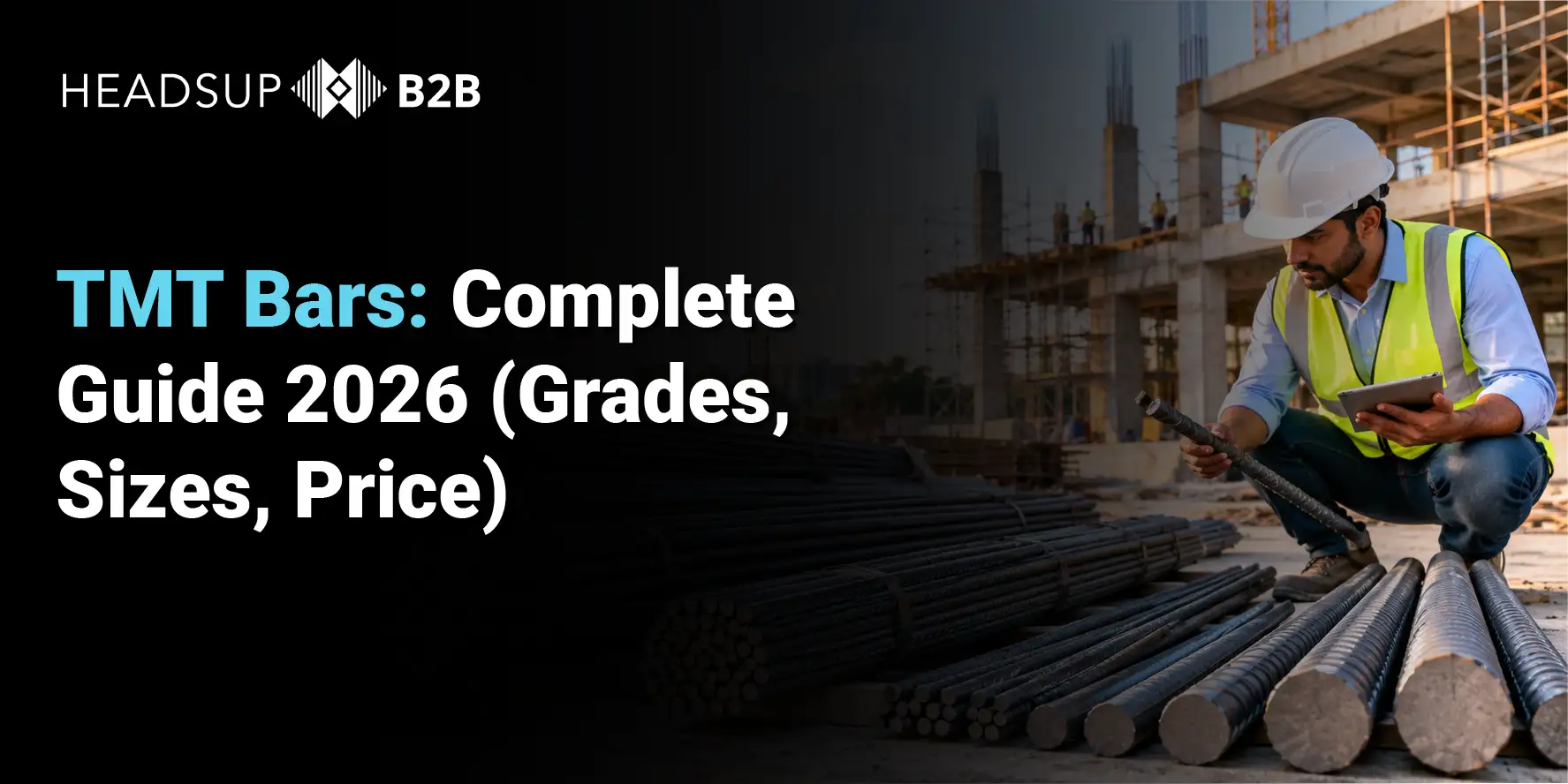
India consumed around 164 million tonnes of finished steel in FY26, and consumption grew 8.3% year-on-year in the first quarter of FY27. Reinforcement bars are one of the largest single uses of that steel — every building and bridge depends on them.
The tension is simple. TMT bars look identical on a truck. A secondary bar and a premium primary bar of the same grade can sit side by side and no one on site can tell them apart. The difference is on paper — in the grade marking, the BIS licence and the mill test certificate. Buyers who check the paper buy good steel. Buyers who check only the price take a chance.
1. What TMT Bars Are and How They Are Made
TMT stands for Thermo-Mechanically Treated. A TMT bar is a ribbed steel reinforcement bar that gets its strength from a controlled heat treatment rather than from cold twisting, which older CTD bars relied on.
The three-stage process
Quenching: The hot bar leaving the rolling mill passes through high-pressure water sprays. The outer surface cools instantly and hardens into a tough layer called martensite. The core stays hot.
Self-tempering: Heat from the core flows outwards and tempers the hardened surface. This reduces brittleness while keeping strength.
Atmospheric cooling: The bar cools in open air. The core becomes a soft, ductile ferrite-pearlite structure.
The result is a bar with a hard outer rim and a ductile core. The rim gives strength. The core lets the bar bend and stretch without snapping — which is what keeps a structure standing when it is overloaded or shaken. That combination is the whole point of TMT. For a deeper explanation, see our guide on what TMT steel is.
| Property | TMT bar | Old CTD / mild steel bar |
|---|---|---|
| Strength source | Heat treatment (quench + temper) | Cold twisting / plain rolling |
| Ductility | High — core stays soft | Lower in CTD; twisting adds surface stress |
| Weldability | Good, due to low carbon | Poorer in CTD |
| Earthquake performance | Better energy absorption | Less reliable under cyclic load |
| Current use | Standard for RCC in India | Largely phased out |
2. TMT Bar Grades: Fe 415 to Fe 600
The number in a grade is its minimum yield strength in N/mm² — the stress at which the bar starts to deform permanently. Fe 500 means at least 500 N/mm². IS 1786 also sets the minimum tensile strength and the minimum elongation for each grade.
| Grade | Min. yield strength (N/mm²) | Min. tensile strength (N/mm²) | Min. elongation | Typical use |
|---|---|---|---|---|
| Fe 415 | 415 | 485 | 14.5% | Older designs, light structures |
| Fe 415D | 415 | 500 | 18.0% | Where very high ductility is specified |
| Fe 500 | 500 | 545 | 12.0% | Low-rise residential |
| Fe 500D | 500 | 565 | 16.0% | Residential and commercial — the common default |
| Fe 550 | 550 | 585 | 10.0% | Heavy commercial |
| Fe 550D | 550 | 600 | 14.5% | High-rise, bridges, industrial |
| Fe 600 | 600 | 660 | 10.0% | Specialised heavy infrastructure |
A higher grade is not automatically better. It is stronger, but the non-D higher grades stretch less before failure. The right grade is the one your structural engineer specifies. Our detailed guide to TMT bar grades compares each grade in depth.
3. The “D” Grades and Why They Matter
The “D” stands for ductility. D-grade bars must meet higher elongation limits and a higher ratio of tensile to yield strength, and tighter limits on sulphur and phosphorus. In practice, a D bar gives more warning before it fails. It bends and stretches. It does not snap.
That matters in most of India. Large parts of the country, including Delhi NCR, sit in seismic Zones III, IV and V. In an earthquake, the structure has to absorb energy through repeated bending. A ductile bar does that. A brittle one does not.
⚠ WHEN TO INSIST ON A “D” GRADE
- Any project in seismic Zone III, IV or V.
- Columns, beams and joints that carry cyclic or dynamic loads.
- Multi-storey residential and commercial buildings.
- When the drawings specify ductile detailing — follow the drawing, not the dealer.
The premium for a D grade over its non-D counterpart is usually small compared with total project cost. On most structural projects, it is the safer default.
4. TMT Bar Sizes, Weights and Uses
TMT bars are sold in standard 12-metre lengths, in diameters from 8mm to 32mm and above. Weight per metre follows the formula D²/162, where D is the diameter in mm.
| Size | Weight / metre (kg) | Weight / 12m bar (kg) | Approx. bars per tonne | Typical use |
|---|---|---|---|---|
| 8mm | 0.395 | 4.74 | 211 | Stirrups, slab mesh, lintels |
| 10mm | 0.617 | 7.41 | 135 | Slabs, small beams, stirrups |
| 12mm | 0.889 | 10.67 | 94 | Beams, columns, slabs |
| 16mm | 1.580 | 18.96 | 53 | Columns, footings, beams |
| 20mm | 2.469 | 29.63 | 34 | Heavy columns, raft foundations |
| 25mm | 3.858 | 46.30 | 22 | High-rise columns, bridges |
| 32mm | 6.321 | 75.85 | 13 | Heavy infrastructure, deep foundations |
Two practical points. Smaller diameters usually cost more per kg because they take longer to roll. And bars may be billed on theoretical weight or on actual weighbridge weight — ask which before you compare. Use the TMT bar weight calculator for quick conversions.
5. Primary vs Secondary TMT Bars
Primary producers make steel from iron ore in integrated plants and roll it into bars. Secondary producers make bars from billets, sponge iron or scrap, often in induction-furnace and re-rolling units.
Secondary steel is a large part of the market. Secondary producers, including MSMEs, held about 47% of India’s crude steel capacity in FY25. Secondary does not mean substandard: a BIS-certified secondary bar must meet the same IS 1786 grade requirements as a primary bar.
| Factor | Primary TMT | Secondary TMT (BIS-certified) |
|---|---|---|
| Raw material | Iron ore in integrated plants | Billets, sponge iron, scrap |
| Batch consistency | Generally tighter | Varies by producer — check every lot |
| Price position | Higher (approx. upper band) | Lower (approx. lower band) |
| Documentation | MTC usually standard | Insist on MTC for every batch |
| Best fit | High-rise, infrastructure, spec-driven projects | Cost-sensitive low and mid-rise work |
For a ranked view of manufacturers, see top TMT bar brands in India.
6. TMT Bar Price: What You Will Actually Pay
⚠ PRICE NOTE — APPROXIMATE FIGURES ONLY
- All prices in this guide are approximate market ranges for reference only.
- They are not actual selling prices and not a price offer or commitment from Headsup B2B.
- No claim can be made against Headsup B2B on the basis of these figures.
- Actual prices depend on brand, grade, size, quantity, location and date — request a written quote.
TMT prices move with iron ore, coking coal, scrap and construction demand, and change week to week. Public listings in Delhi NCR in late September 2026 placed most bars in an approximate band of ₹45–65 per kg before GST, with premium primary brands quoted higher. City and dealer rates vary.
What moves the price you pay
| Price driver | Approximate effect | What to do |
|---|---|---|
| Brand tier | Largest single difference between quotes | Compare within the same tier |
| Grade | Higher grades carry a small premium | Buy the grade the drawing specifies |
| Size | 8mm–10mm usually costlier per kg | Price the full size mix, not one size |
| GST | Adds 18% to the base price | Confirm whether quotes include GST |
| Freight and unloading | Adds more for distant mills and small lots | Compare delivered-to-site prices |
| Order size | Bulk lots open distributor pricing | Consolidate into 15–25 tonne orders |
The number that matters is landed cost — base price plus GST, freight and unloading. In our detailed TMT bar price in Delhi NCR guide, an illustrative 10-tonne order lands roughly 20% above its base quote once these are added.
7. How Much Steel Your Project Needs
Final steel quantity always comes from the structural drawings and the bar bending schedule. For early budgeting, builders often use a thumb rule of approximately 3.5 to 4.5 kg of steel per sq ft of built-up area for typical residential RCC frame buildings. The actual figure depends on design, soil, floors and seismic zone.
ILLUSTRATIVE STEEL BUDGET (APPROX.) — 2,000 SQ FT G+1 RESIDENTIAL
| Variable | Assumption | Approx. steel (tonnes) | Impact on budget |
|---|---|---|---|
| Lean design | 3.5 kg / sq ft | 7.0 | ≈ ₹68,000 lower than base case |
| ✓ Base case | 4.0 kg / sq ft | 8.0 | Reference for early budgeting |
| Heavier design / higher zone | 4.5 kg / sq ft | 9.0 | ≈ ₹68,000 higher than base case |
| Add 3% wastage | On base case | 8.24 | ≈ ₹16,000 higher |
Budget steel on landed cost and the drawing — never on the base quote and a thumb rule alone.— Headsup B2B Procurement Research, October 2026
8. Quality Checks Before You Accept Delivery
BIS mark and licence number
TMT bars sold in India must carry BIS certification under IS 1786. Check that the ISI mark and the CM/L licence number are rolled onto the bar at regular intervals.
Grade and brand marking
The grade (for example, 500D) and the producer’s name or logo should be embossed on the bar. Bars without legible markings should be rejected.
Mill test certificate (MTC)
Ask for the MTC for each heat or batch. It shows yield strength, tensile strength, elongation and chemical composition. Match it against the grade ordered.
Weight and dimensions
Weigh at delivery. Compare the weighbridge slip with the invoice and check a sample bar against its theoretical weight.
Surface and storage
Light surface rust is normal. Pitting, flaking and cracks are not. Store bars off the ground and covered.
⚠ RED FLAGS ON DELIVERY
- No MTC, or an MTC that does not match the batch.
- Missing or unreadable BIS licence number on the bar.
- Weighbridge weight well below the invoiced weight.
- Bars with uneven ribs, cracks or heavy scaling.
- A price far below the market band with no explanation.
9. How to Buy TMT Bars in Bulk
Small orders under about five tonnes usually come from a local dealer. From around 15–25 tonnes, distributor and mill-linked pricing becomes available and freight per tonne drops. Large and repeat buyers gain most from planning orders around the full bar bending schedule rather than buying size by size.
Before placing any order, get the quote in writing with grade, brand, size-wise quantity, rate basis, GST status, freight, unloading, validity and payment terms. A quote missing any of these is not comparable.
Headsup B2B sources primary and BIS-certified secondary TMT bars through a verified supplier network, with pan-India delivery and credit for verified buyers. See our bulk TMT bars buying guide and explore TMT bars supply on the Metal Solutions page.
Frequently Asked Questions
Q. What is a TMT bar?
A TMT (Thermo-Mechanically Treated) bar is a ribbed steel reinforcement bar with a hard outer layer and a ductile core, created by quenching and self-tempering. It is the standard reinforcement for RCC construction in India.
Q. Which TMT grade is best for house construction?
Fe 500D is the most common choice for residential buildings, especially in seismic zones. The final grade should always follow your structural engineer’s design.
Q. What is the difference between Fe 500 and Fe 500D?
Both have a minimum yield strength of 500 N/mm². Fe 500D must meet a higher minimum elongation (16% vs 12%) and stricter chemical limits, so it bends further before failing.
Q. How do I calculate TMT bar weight?
Use D²/162, where D is the diameter in mm, to get weight in kg per metre. A 12mm bar weighs about 0.889 kg per metre, or about 10.67 kg per 12-metre length.
Q. Are secondary TMT bars safe?
BIS-certified secondary bars must meet the same IS 1786 requirements as primary bars. Consistency can vary, so check the ISI mark, licence number and mill test certificate for every lot.
Q. What is the approximate price of TMT bars in India?
Public listings in Delhi NCR in late September 2026 showed an approximate band of ₹45–65 per kg before GST, with premium brands higher. These are approximate figures, not actual prices — ask for a dated written quote.
Q. How much steel is needed per sq ft for a house?
A common early-budget thumb rule is approximately 3.5–4.5 kg per sq ft of built-up area for residential RCC buildings. The actual quantity comes from the structural drawings.
Q. How can I check TMT bar quality on site?
Check the embossed ISI mark, licence number and grade, match the mill test certificate to the batch, and weigh the delivery against the invoice.
Source TMT Bars for Your Next Project
-
- ✓ Primary and BIS-certified secondary brands
- ✓ Fe 500, Fe 500D and Fe 550D in 8mm–32mm
- ✓ Pan-India delivery from a verified supplier network
- ✓ Credit for verified buyers
Share
